
Harris Rallies Democrats, Portrays Trump as Threat to American Values
Vice President Kamala Harris concluded an extraordinary month in modern political history with a powerful speech Thursday night, rallying Democrats around themes of patriotism and framing Donald Trump as a threat to fundamental American principles.
“In the enduring struggle between democracy and tyranny, I know where I stand. And I know where the United States belongs,” Harris declared, underscoring her commitment to democratic values.
With the precision of a seasoned prosecutor, Harris delivered on the promise many Democrats recognized when she first launched her presidential campaign five years ago and when Joe Biden selected her as his running mate in 2020.
Harris didn’t shy away from confronting her Republican rival. She outlined Trump’s ongoing legal challenges, criticized him for the hardships faced by women under strict state-level abortion laws, and reminded the audience of the “chaos and calamity” during his time in office.
Harris Promises a Return to Pre-Trump Normalcy
In a powerful address, Kamala Harris sent a clear message to Americans: “You don’t have to live like this anymore.” With her remarks, she emphasized a decisive break from the Trump era, marked by uncertainty and political turmoil.
Harris consistently asserted, “We are not going back,” echoing the sentiments of the thousands of supporters at the United Center. This slogan not only challenges Trump’s policies but also serves as a promise of progressive change, providing reassurance for the immediate future.issues such as reproductive rights as a question of government interference.
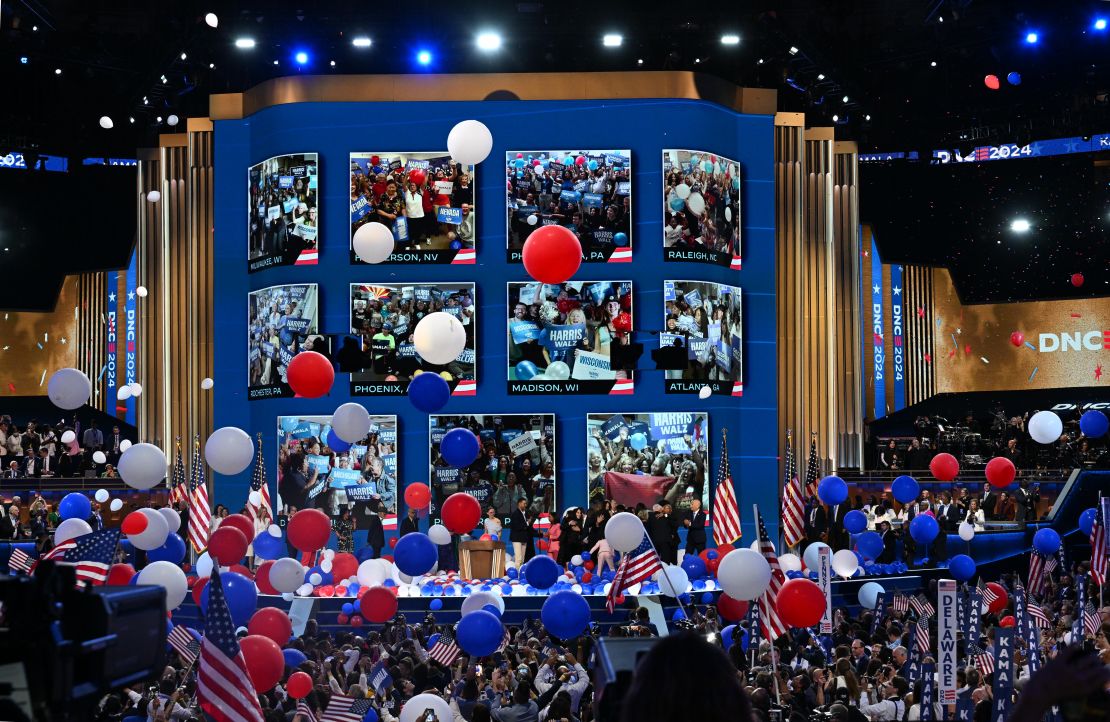
Balloons fall at the finale of the Democratic National Convention in Chicago, on August 23, 2024.
Bernadette Tuazon/CNN
Her campaign has highlighted the theme of “freedom,” framing key issues like reproductive rights as matters of government interference. Harris stressed that the upcoming election hinges on various freedoms, including: “the freedom to live safely from gun violence in our schools, communities, and places of worship; the freedom to love openly and proudly; the freedom to breathe clean air, drink clean water, and live free from pollution that drives the climate crisis; and, ultimately, the freedom to vote.”
On this night, Harris’s call for “freedom” resonated deeply, inviting Americans to envision a future free from the anger and divisions that have characterized much of the last decade.
Harris Shares Personal Journey, Reflects on Influences That Shaped Her Career
Kamala Harris, who has historically found it difficult to open up about her personal life, is now sharing more of her story with voters.
During her brief campaign, Harris has increasingly discussed her background, including her childhood in a middle-class family as the daughter of immigrant academics and her path into political office.
On Thursday, Harris spoke about her father, economist Donald Harris, recalling how he encouraged her to run free on the playground despite her mother’s caution. She also paid tribute to her late mother, Shyamala Gopalan Harris, a biomedical scientist dedicated to finding a cure for breast cancer, who raised Harris and her sister, Maya, after her divorce. Harris emphasized the support she received from the close-knit community that helped raise them.
“My mother was a brilliant, five-foot-tall, brown woman with an accent, and as the eldest child, I saw how the world would sometimes treat her,” Harris said. “But my mother never lost her cool.”
While Harris did not directly compare her upbringing with that of former President Trump, other speakers this week drew contrasts between her childhood and Trump’s life as the son of a real estate mogul.
Harris also shared a pivotal experience from her high school years that influenced her decision to become a prosecutor. She recounted how her friend Wanda Kagan confided in her about being sexually abused by her stepfather. Harris invited her friend to stay with her family.
“This is one of the reasons I became a prosecutor, to protect people like Wanda,” Harris explained.
Harris’ Allies Highlight Her Career Achievements
During her 2020 presidential campaign, Kamala Harris worked to distance herself from the label of being a “cop” and counter criticisms that she was out of step with the left on criminal justice reform. Now, as she reintroduces herself to the public as a presidential candidate, Harris is embracing her professional background as a strength. Each night of the campaign has showcased her work combating transnational gangs, prosecuting sexual abusers, and holding corporate wrongdoers accountable.
On Thursday night, several former colleagues from her time in the Alameda County district attorney’s office and her tenure as California attorney general spoke in support of Harris, emphasizing her dedication and compassion.
“For Kamala, practicing law was always about protecting the vulnerable and giving the victims a voice,” said Amy Resner, a former deputy district attorney for Alameda County and a longtime friend.
Lisa Madigan, the former attorney general of Illinois, highlighted her collaboration with Harris during the financial crisis to prevent foreclosures on struggling families. Nathan Hornes, a former student at the now-defunct Corinthian Colleges, recounted Harris’s successful efforts to prosecute the institution for defrauding students.
One of the most compelling testimonies came from Courtney Baldwin, a youth organizer and human trafficking survivor. Baldwin shared how Harris worked to shut down the website used by traffickers to exploit her and others.
“She’s protected people like me her whole life,” Baldwin stated.
Meet the Harris Family: A Personal Glimpse into Kamala Harris’ Support System
For years, Donald Trump and many Republicans have made a point of mispronouncing Kamala Harris’ first name. On Thursday night, Harris’ two young grandnieces, Amara and Leela Ajagu, took to the stage—joined by actress Kerry Washington—to set the record straight: pronouncing her name is so simple that even children can do it.
“First you say comma, like a comma in a sentence,” explained Amara.
“Then you say la, like la, la, la, la, la,” added Leela in a sing-song voice, as other Harris family members joined them on stage.
Meena Harris, Kamala’s niece and the mother of Amara and Leela, shared how the vice president has been a guiding force in her life and now guides her children. Harris’ stepdaughter, Ella Emhoff, reflected on their first meeting when she was 14, describing Harris as “patient, caring, and always took me seriously.”
“She taught me that making a difference means giving your whole heart and taking action,” said Harris’ goddaughter, Helena Hudlin.
Later in the evening, Harris’ sister, Maya Harris, spoke fondly of their late mother, who passed away in 2009.
“I so wish that Mommy could be here tonight,” Maya said. “I can just see her smiling, saying how proud she is of Kamala. And then, without missing a beat, she’d say, ‘That’s enough, you’ve got work to do.’”
Powerful Stories of Gun Violence Survivors Highlighted at the Convention
Even before President Biden launched his reelection campaign, Vice President Kamala Harris had established herself as a leading voice on gun control within the administration. This was underscored on Thursday night as the convention spotlighted the personal stories of those affected by gun violence, from mass shootings to domestic murders. The approach mirrored the earlier focus on personal abortion stories throughout the week. Against a somber black backdrop, speakers shared their experiences of profound loss.
In a poignant video, Georgia Representative Lucy McBath shared her story of becoming a parent before her son was murdered in 2012. McBath, who has cited her son’s death as her motivation for entering politics, spoke of learning “firsthand the power of telling our stories” while working with gun control organizations like Moms Demand Action.
“You’ve just heard mine, but there are many more to tell,” McBath said, before introducing other speakers: mothers who lost their children in the Sandy Hook and Uvalde school shootings; Melody McFadden, who lost her mother to domestic violence; and Edgar Vilchez, who lost a classmate to gun violence.
The segment on gun violence concluded with a powerful appearance by former Arizona Representative Gabby Giffords, who survived a shooting at a campaign event in 2011.
“I almost died, but I fought for my life, and I survived,” Giffords said, closing the night with her message of resilience.
‘Central Park Five’ Member Condemns Trump: ‘He Wanted Us Dead’
Donald Trump has a long history of leveraging racial tensions for political gain, from promoting the “birtherism” conspiracy against Barack Obama to instituting a travel ban targeting six majority-Muslim countries. However, his foray into this brand of politics began with the infamous “Central Park Five” case.
In 1989, five Black and Latino boys were wrongfully convicted of raping and assaulting a woman in New York City’s Central Park. At the time, Trump, then a New York real estate developer, took out full-page newspaper ads calling for the boys to be executed.
“Bring back the death penalty. Bring back our police!” the ads demanded in bold, large print.
The boys were later exonerated—four in 2002 and the fifth in 2022—after another man confessed to the crime, with DNA evidence confirming his involvement.
On Thursday night, four of the five exonerated men appeared on stage at the Democratic National Convention.
“Every day as we walked into the courtroom, people screamed at us, threatened us, because of Donald Trump,” said Korey Wise.
Yusef Salaam, now a New York City councilman, recalled Trump’s harsh stance against them: “He wanted us dead.”
“He has never changed, and he never will,” Salaam added. “That man thinks that hate is the animating force in America. It is not. We have the constitutional right to vote. In fact, it is a human right. So let us use it.”
Gaza War Opponents Denied Speaking Slot by DNC
“Uncommitted” delegates, who were elected through primary protest votes against the Biden administration’s policy on Israel and Gaza, were ultimately denied a speaking slot at the Democratic National Convention.
Leaders of the Uncommitted National Movement, who have pledged to vote for Kamala Harris, advocated for a Palestinian American to speak to the convention audience inside the United Center. However, on Wednesday night, they were informed by convention organizers that their request had been rejected, as conveyed by an Uncommitted spokesperson.
In response, the group staged a 24-hour sit-in outside the convention, drawing support from progressive lawmakers, antiwar activists, and influential organizations like the United Auto Workers. Despite this show of support, the Democratic Party upheld its decision.
Abbas Alawieh, co-founder of the Uncommitted movement, criticized the DNC’s decision as counterproductive, arguing it could hinder efforts to regain support in key swing states such as Michigan. “I feel bad for the DNC and the Harris campaign because they’re out of step with the majority of the Democratic base,” Alawieh said. “The majority of Democratic voters believe that Palestinian human rights are a priority alongside every other priority we have.”
Vice President Harris addressed the issue by affirming her support for Israel, condemning the atrocities committed by Hamas during the October 7 attacks, and emphasizing the administration’s commitment to securing lasting peace in the region. “At the same time,” Harris noted, “what has happened in Gaza over the last 10 months is devastating. So many innocent lives lost. Desperate, hungry people fleeing for safety over and over again. The scale of suffering is heartbreaking.”
Celebrities Make Their Mark at the DNC
Measuring momentum in politics often involves assessing crowd size, donations, and voter registration. However, this convention introduced a new benchmark: celebrity appearances.
Throughout the week, the DNC has featured a range of stars. Lil Jon made a surprise appearance during the roll call, while Oprah Winfrey delivered a speech on Wednesday night. Other celebrities, including Mindy Kaling and Tony Goldwyn, hosted various segments of the convention. Progressive country artists like Mickey Guyton, Maren Morris, and Jason Isbell performed throughout the week.
Stevie Wonder captivated the audience with “Higher Ground,” and John Legend, joined by Sheila E., paid tribute to Prince from Minnesota, Governor Tim Walz’s home state. Pink closed out the final night with a performance of “What About Us,” which was hosted by “Scandal” star Kerry Washington.
While only the convention organizers know who sought invitations after Kamala Harris became the nominee, it’s evident that her rise coincided with a surge of high-profile energy reflected in the programming.
There was also much speculation about whether Beyoncé would perform, given that her song “Freedom” has become an anthem for Harris’ campaign and featured in several campaign videos. Throughout the week, rumors circulated that Beyoncé might make an appearance, with several sources close to the convention planners expressing optimism. However, late Thursday, the artist’s team confirmed, “She was never scheduled to be in Chicago,” according to a representative speaking to DFN.